
- Book your home inspection online today and save $25 on your next inspection! BOOK NOW!
-
 617-615-9559
 617-615-9559
Fill up the form and we will reach out to help you set up a suitable time slot for your property inspection.

A home can look perfectly fine from the inside and still be hiding serious problems. Wet insulation, active leaks, overloaded electrical circuits, and pest activity don’t always show up on the surface. That’s exactly where thermal imaging changes what an inspection can tell you.
Thermal images of homes give inspectors a way to see temperature variations across walls, ceilings, floors, and other surfaces that would otherwise require cutting into drywall or guessing based on visible symptoms.
For buyers, sellers, and homeowners in the Greater Boston area, understanding what this technology actually does, and what it doesn’t, helps you get the most out of the inspection process.
Thermal imaging uses specialized infrared cameras to detect radiation emitted by objects and convert it into visible images. Every surface in a home radiates heat at a slightly different level.
When something is wrong, such as water behind a wall, missing insulation, or an overheating electrical component, the temperature pattern changes in a way the camera can detect and display as a color-coded picture.
The result is a visual map of temperature differences, not actual moisture or defects themselves. A cold spot on a wall doesn’t automatically mean there’s a leak. It means something is affecting the temperature in that area, which gives an inspector a reason to investigate further.
Thermal imaging is a non-invasive process, meaning inspectors can gather significant information without opening walls or disturbing the structure of the home.
For optimal results, a significant temperature difference of at least 15 to 20 degrees Fahrenheit between indoor and outdoor temperatures is most effective. This is one reason winter inspections in New England tend to produce particularly clear infrared results.
Visual idea: Side-by-side Canva graphic showing a normal wall photo next to its thermal image, with a color scale labeled from cool to warm.
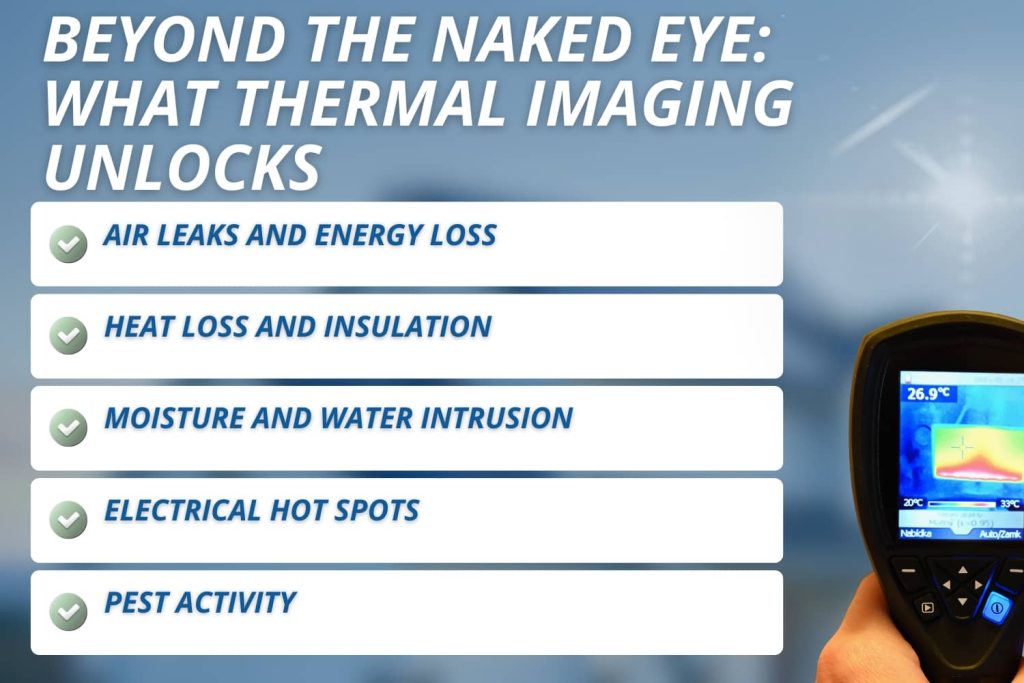
Using thermal imaging during home inspections can help identify energy leaks, allowing homeowners to make repairs that can save them up to 20 percent annually on energy bills. Here are the key areas where infrared scanning adds real diagnostic value.
Air leaks reveal drafts around windows, doors, electrical outlets, and attic hatches where conditioned air is escaping. Thermal imaging can identify these leaks, which account for an estimated 10 to 20 percent of total home energy loss. Beyond obvious gaps, thermal imaging can reveal hidden issues such as cold air infiltration through unsealed floorboards and drafty loft hatches that are not visible to the naked eye.
In many cases, Blower Door Tests are used alongside thermal imaging to exaggerate air leaks and make them clearer on infrared cameras. Together, these tools give a much more complete picture of where a home’s building envelope is failing and what’s driving up heating and cooling costs.
Common problems detected by thermal imaging include missing or improperly installed insulation, which can result in increased heating costs and discomfort during winter months. An infrared scan can pinpoint sections of exterior walls, attic insulation, and ceiling areas where insulation has settled, shifted, or was never correctly installed, helping homeowners improve energy efficiency in targeted areas rather than guessing.
This is especially relevant in older homes throughout Newton, Waltham, Medford, and Somerville, where original wall insulation may be decades old and significantly underperforming. The difference between a properly insulated exterior wall and a failing one shows up immediately in a winter thermal image, making it a practical first step toward creating a more energy-efficient home.
Thermal cameras can indirectly detect moisture by identifying temperature anomalies caused by evaporative cooling or thermal capacitance. Water-affected building materials cool differently from dry ones, making infrared scanning useful for identifying roof leaks, plumbing leaks behind the walls, basement moisture intrusion, and water entering through windows or door frames without visible surface stains.
In older New England homes that have been through decades of freeze-thaw cycles, moisture problems are common and frequently hidden. Identifying cold spots and wet areas through thermal imaging can reduce energy bills and prevent costly repairs by catching issues before they escalate into structural damage or mold growth.
Overloaded circuits, loose connections, and failing components generate excess heat before they fail visibly. Thermal imagers can detect these hot spots in electrical panels, outlets, and wiring before they become a fire hazard. Finding an overheating breaker or a loose connection during an inspection is far preferable to discovering it through a burning smell or a tripped breaker.
Certain pest infestations, particularly termites and rodents, can generate heat signatures that show up in thermal images. Termite activity creates warmth in affected wood, and rodent nesting areas retain heat differently than the surrounding structure. Thermal imaging won’t confirm a pest infestation on its own, but it can flag areas worth a closer look during a dedicated pest inspection.
Visual idea: Canva graphic showing four thermal image examples with captions: moisture behind the wall, insulation gap, electrical hot spot, air leak around the window frame.
Understanding the limits of infrared scanning is just as important as knowing its strengths. Thermal imaging cameras detect surface temperatures, not what’s physically inside a wall.
Conditions need to be right for meaningful results, and on a mild day when indoor and outdoor temperatures are close, findings related to insulation and air leaks may not be visible at all.
A temperature anomaly also cannot identify its own cause. A cool spot on a ceiling might indicate a leak, a missing insulation batt, or simply an HVAC airflow effect.
Experienced inspectors use thermal images as one layer of evidence, combining findings with moisture meters, visual inspection, and knowledge of building materials and systems to reach accurate conclusions.
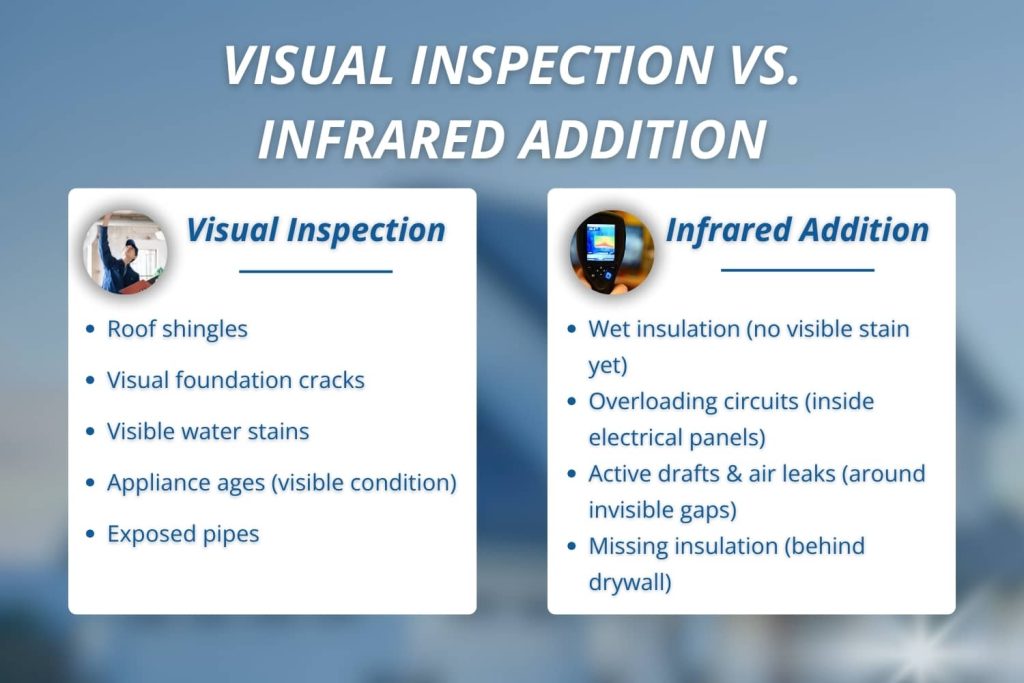
A standard home inspection covers the visible and accessible components of a property, including the roof, foundation, electrical system, plumbing, HVAC, and interior living spaces. Infrared scanning adds a layer of diagnostic capability that a visual inspection alone cannot provide.
|
Standard Inspection |
With Infrared Scanning | |
|---|---|---|
|
Visible defects |
Yes |
Yes |
|
Hidden moisture |
Limited |
Yes |
|
Insulation gaps |
Limited |
Yes |
|
Electrical hot spots |
Limited |
Yes |
|
Air leaks and energy loss |
Limited |
Yes |
|
Pest activity clues |
Limited |
Sometimes |
For buyers purchasing older homes in Greater Boston, where decades of renovations and deferred maintenance can hide a wide range of problems, adding infrared scanning to a standard inspection is a practical step toward making informed decisions about the property.
What are the most common issues found during a home inspection in Greater Boston?
Older homes throughout Newton, Waltham, Quincy, Medford, and Somerville frequently turn up aging electrical panels, older plumbing materials, moisture in basements and crawl spaces, and deferred maintenance that accumulates over decades. Many of these findings point toward follow-up testing or specialized inspections, depending on what the inspector observes.
How does radon enter a home, and what are the risks for Massachusetts residents?
Radon is a naturally occurring radioactive gas that seeps into homes through cracks and gaps in the foundation and building envelope. It has no odor or color, making it undetectable without testing. Massachusetts homes with basements or below-grade living spaces are particularly worth testing, as radon can accumulate to levels that pose a long-term health risk with no visible symptoms.
What should homeowners know about indoor air quality testing?
Indoor air quality testing identifies airborne contaminants that aren’t visible and don’t always produce obvious symptoms right away. Mold spores, volatile organic compounds, and other pollutants can build up in homes with poor ventilation, moisture issues, or aging building materials. Testing provides a baseline measurement of what’s present in the air and helps homeowners understand whether conditions inside the home require attention.
What does a termite inspection cover that a standard inspection doesn’t?
A standard home inspection notes visible signs of wood damage, but it isn’t designed to confirm active infestations or identify specific wood-destroying organisms. A dedicated termite inspection looks specifically for evidence of termites, carpenter ants, wood-boring beetles, and similar pests, including mud tubes, frass, hollow wood, and entry points near the foundation that a general inspector isn’t trained to evaluate in the same depth.
Thermal imaging is most valuable when performed by an inspector who knows how to interpret what the camera reveals. Temperature anomalies need context, and without experience reading infrared images alongside the rest of a property’s condition, findings can be misread in either direction.
Consider scheduling an inspection that includes infrared scanning when you are buying an older home in the Greater Boston area, dealing with unexplained energy costs or moisture issues, concerned about wall insulation or building envelope performance, or purchasing a property where previous water damage or pest activity is known or suspected.<p dir=”ltr”>R&C Inspectors serves homeowners and buyers throughout Newton, Waltham, Quincy, Medford, Somerville, and surrounding communities, offering home inspection, infrared scanning, radon gas testing, indoor air quality testing, termite inspection, pest inspection, and water quality testing.
Thermal images of homes reveal what standard visual inspections can’t. Hidden moisture, insulation failures, electrical hot spots, and air leaks all show up in ways that help ins
pectors give buyers and homeowners a clearer, more complete picture of the property.
For anyone purchasing or maintaining a home in Greater Boston, infrared scanning is one of the more practical tools available for catching problems before they become expensive ones and for
making informed decisions about one of the most significant investments you’ll make.
Schedule your inspection with R&C Inspectors and find out what’s behind your walls.