
- Book your home inspection online today and save $25 on your next inspection! BOOK NOW!
-
 617-615-9559
 617-615-9559
Fill up the form and we will reach out to help you set up a suitable time slot for your property inspection.
Some air purifiers can reduce VOCs, but most cannot, and choosing the wrong one gives you a false sense of security. VOCs (volatile organic compounds) are gas-phase chemicals, and most air purifiers are built to catch particles like dust, not gases. At R&C Inspectors, we test indoor air quality throughout Greater Boston and see firsthand how often invisible chemical contaminants go undetected. This guide explains what VOCs are, which air purifiers actually work, and when professional testing is the smarter first step.
VOCs are carbon-based chemicals that evaporate into the air at room temperature. They come from hundreds of products found in ordinary homes: paints, cleaning sprays, adhesives, new furniture, flooring, and building materials. Many are odorless, which makes them especially easy to miss.
According to the U.S. EPA’s indoor air quality guidance, indoor VOC concentrations run 2 to 5 times higher than outdoor levels, and can spike up to 10 times higher in some cases. In New England, where homes stay sealed for most of the year, that buildup gets worse with every winter.
The most frequently detected VOCs in residential settings include:
Homes that have been recently renovated, newly built, or furnished with particleboard-heavy pieces tend to have the highest initial off-gassing levels. In Greater Boston’s colder months, tightly sealed homes trap these gases with little chance for dilution.
Short-term exposure to elevated VOC levels can cause eye and throat irritation, headaches, dizziness, and nausea. Symptoms often appear during or shortly after using VOC-emitting products and typically clear up when you move to fresh air.
Long-term or chronic exposure is more serious. Prolonged contact with certain VOCs has been linked to liver and kidney damage, nervous system effects, and increased cancer risk. The American Lung Association notes that some VOCs, including benzene and formaldehyde, are known or probable human carcinogens. Children, seniors, and people with asthma or respiratory conditions face the greatest risk.
VOC sources fall into a few categories you’ll find in nearly every home:
One common misconception: labeling something “natural” or “green” does not mean it is VOC-free. Many scented products marketed as natural emit VOCs at levels comparable to standard products.
Air purifiers can reduce VOC levels, but only specific types are effective, and the difference matters.
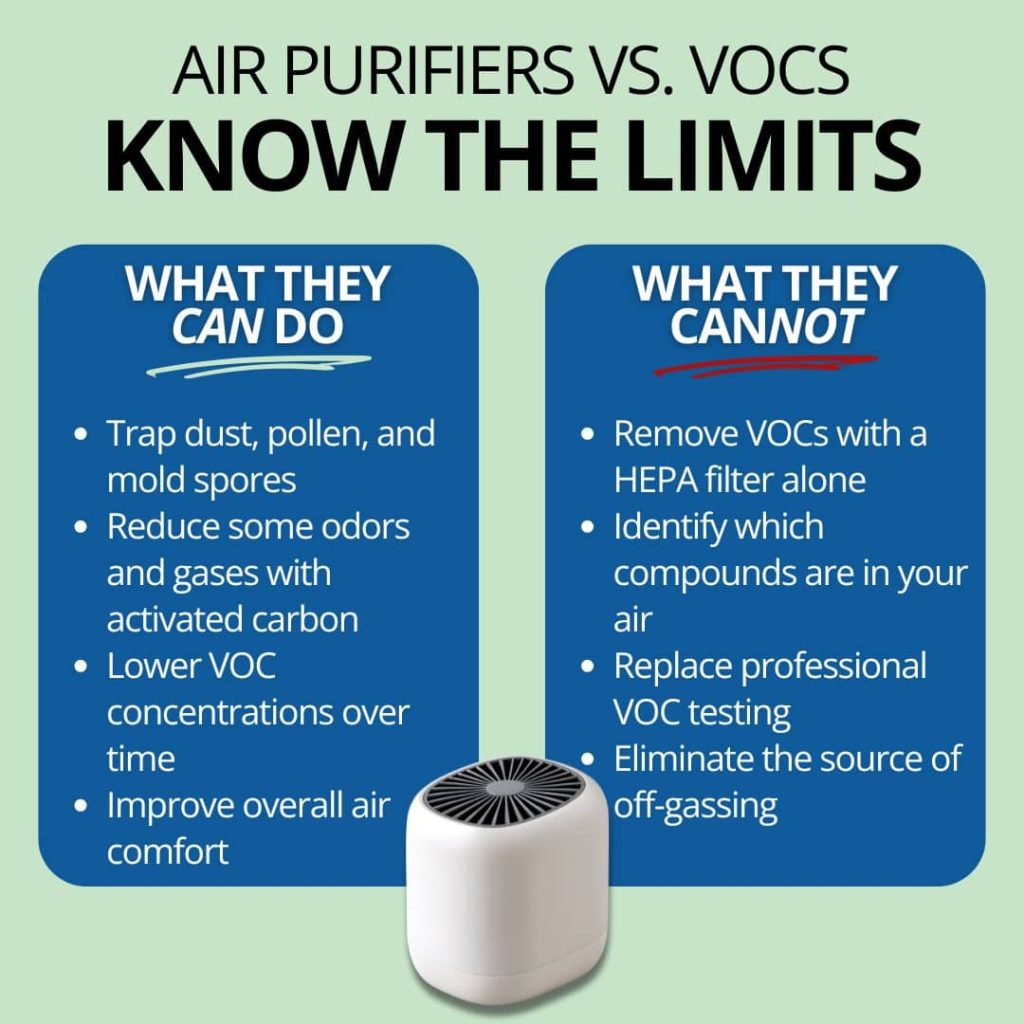
Most air purifiers on the market are built around particle filtration. They are designed to capture solid airborne debris like dust, pollen, and pet dander. VOCs are gases, not particles, so particle-capture technology does not address them at all.
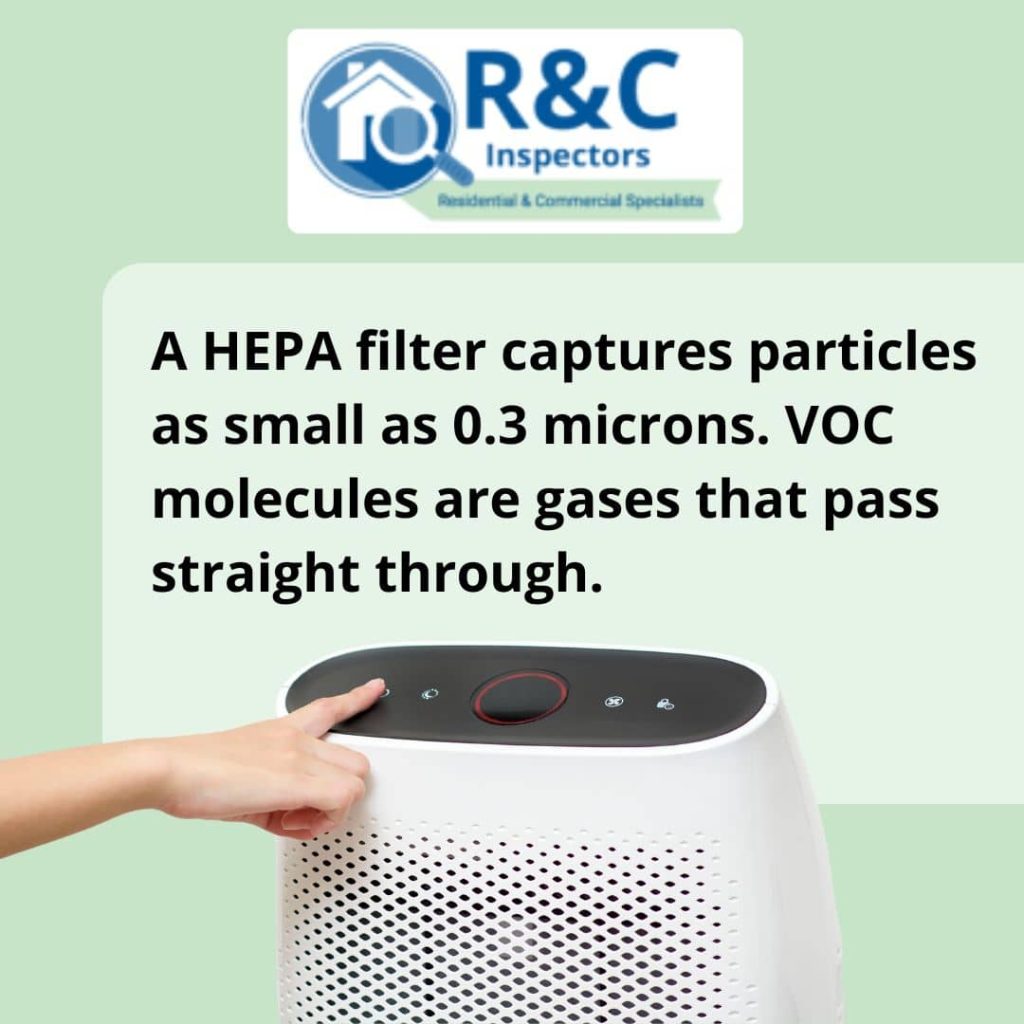
HEPA filters are the gold standard for particle removal. They capture particles as small as 0.3 microns with 99.97% efficiency. The problem is that VOC molecules are orders of magnitude smaller, often under 0.001 microns in diameter. They pass straight through HEPA media without being captured.
Running a HEPA-only purifier in a room with elevated VOCs will clean the particles in the air, but leave the chemical gases entirely untouched. If you have recently painted, installed flooring, or moved into a newly built home, a HEPA filter alone is not a solution for the off-gassing you are dealing with.
Air purifiers designed to reduce VOCs use gas-phase filtration, primarily through activated carbon (also called activated charcoal). Activated carbon has an extremely porous structure that creates a massive internal surface area. As air passes through the filter, VOC molecules adsorb onto the carbon surface and are trapped.
Key factors that determine how well an activated carbon filter performs:
Technologies to avoid: ozone generators and some UV/PCO systems. Ozone generators produce ozone as a cleaning mechanism, but ozone is a respiratory irritant and does not effectively break down most VOCs. Some UV-based systems marketed for VOC removal generate formaldehyde and other harmful byproducts during operation.
The most effective approach combines activated carbon filtration for gas removal with HEPA filtration for particle capture. Source control (eliminating or reducing VOC-emitting products) and increased ventilation are equally important and should be used alongside any air purifier.
To learn more about our indoor air quality testing services in Greater Boston, see how we evaluate chemical contaminants alongside biological pollutants, combustion gases, and other hidden threats.
An air purifier is one tool, not a complete strategy. These steps reduce VOC exposure more broadly:
No. HEPA filters are designed for solid particles and cannot capture gas molecules. To reduce VOCs, an air purifier needs activated carbon or another form of gas-phase filtration in addition to HEPA media.
Common short-term symptoms include eye, nose, and throat irritation; headaches; dizziness; and nausea. Some people notice symptoms only in certain rooms or after specific activities like cleaning or painting. Long-term exposure has been linked to respiratory problems, organ damage, and increased cancer risk. If symptoms appear consistently indoors and improve when you leave the building, VOCs or another air quality problem may be the cause.
Plants are sometimes promoted as natural air purifiers. While certain houseplants do absorb small amounts of VOCs, the effect is too limited to meaningfully reduce levels in a typical home. The EPA’s research suggests you would need an impractical number of plants to make a measurable difference. Plants can be part of a healthy indoor environment, but they are not a substitute for proper filtration or ventilation.
A professional VOC test identifies the specific chemical compounds present in your air and measures their concentrations. Results typically distinguish individual compounds like formaldehyde, benzene, and toluene from total VOC readings. This matters because some VOCs are far more hazardous than others. A professional report allows you to pinpoint the source and take targeted action rather than guessing.
Off-gassing duration depends on the materials involved. Most VOCs from paints and finishes dissipate within a few weeks with good ventilation. Formaldehyde from pressed wood products can continue to be released for months or years. Heat and humidity accelerate off-gassing rates. In New England homes where cold months mean sealed windows for extended periods, elevated VOC levels from new construction can persist significantly longer than in warmer climates.
Yes, typically. New construction uses large quantities of fresh building materials, adhesives, sealants, paints, and finishes, all of which off-gas VOC compounds during their initial curing period. Newer, more energy-efficient homes are also more tightly sealed, which limits natural ventilation and keeps VOC concentrations higher for longer. Indoor air quality testing is especially valuable in the first year of a new build.
Formaldehyde is a specific VOC. The term “VOC” refers to a broad class of thousands of different carbon-based compounds. Formaldehyde is among the most common and most studied of these, and is classified as a human carcinogen by the EPA. It is found in pressed wood, insulation, and many household products. Other well-known VOCs include benzene, toluene, and xylene. When you see a product labeled “formaldehyde-free,” it may still emit other types of VOCs.
An air purifier with activated carbon filtration is a reasonable step for general VOC reduction. But there are situations where professional testing is the right call first:
R&C Inspectors provides indoor air quality testing in the Greater Boston area, including the detection of chemical pollutants, VOCs such as formaldehyde, combustion gases, and biological contaminants. Our inspectors use professional air sampling equipment, and collected samples are analyzed by an accredited laboratory, giving you specific compound identification, not just a general reading. We serve Newton, Waltham, Quincy, Medford, Somerville, and surrounding communities.
If you are unsure what is in your home’s air, a professional test is a faster and more accurate starting point than buying equipment and hoping it covers your specific contaminants.
Air purifiers can be a useful part of managing VOC exposure in your home, but only if they include activated carbon filtration and sufficient carbon volume. Standard HEPA-only purifiers do not remove VOCs at all.
Key takeaways:
When you need confirmed answers about what is in your air, professional indoor air quality testing is the place to start. Contact R&C Inspectors to schedule a testing appointment in Greater Boston.