
- Book your home inspection online today and save $25 on your next inspection! BOOK NOW!
-
 617-615-9559
 617-615-9559
Fill up the form and we will reach out to help you set up a suitable time slot for your property inspection.
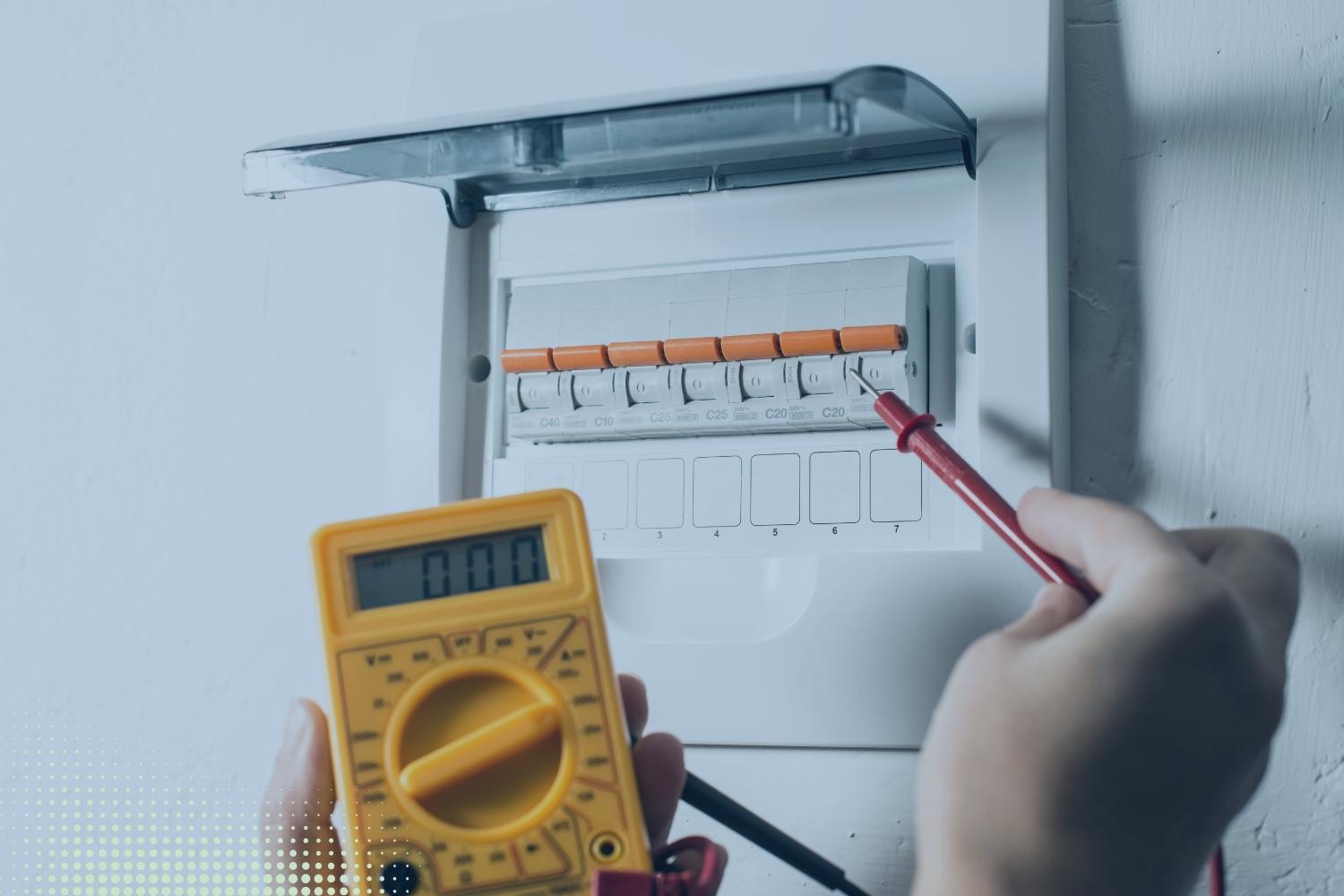
If you just got your home inspection report and the words “double-tapped breaker” are staring back at you, you’re not alone. It’s one of the most common electrical findings our team comes across during residential home inspections, and for most homeowners, it’s the first time they’ve ever heard the term.
The good news? It’s fixable. The important thing is knowing what it means, why it matters, and what to do next. This guide walks you through everything in plain language.
A double-tapped breaker happens when two wires are connected to a single circuit breaker terminal that was designed to hold only one wire. Most breakers have a single terminal screw, and that screw is meant to clamp down firmly on one conductor. When two wires are crammed under that same screw, the connection becomes unreliable, and that’s where problems begin.
A professional home inspection includes opening the electrical panel cover and physically checking each breaker for this exact issue. It’s completely invisible to a homeowner glancing at the outside of the panel.
You might also hear this called “double lugging.” The terms are used interchangeably.
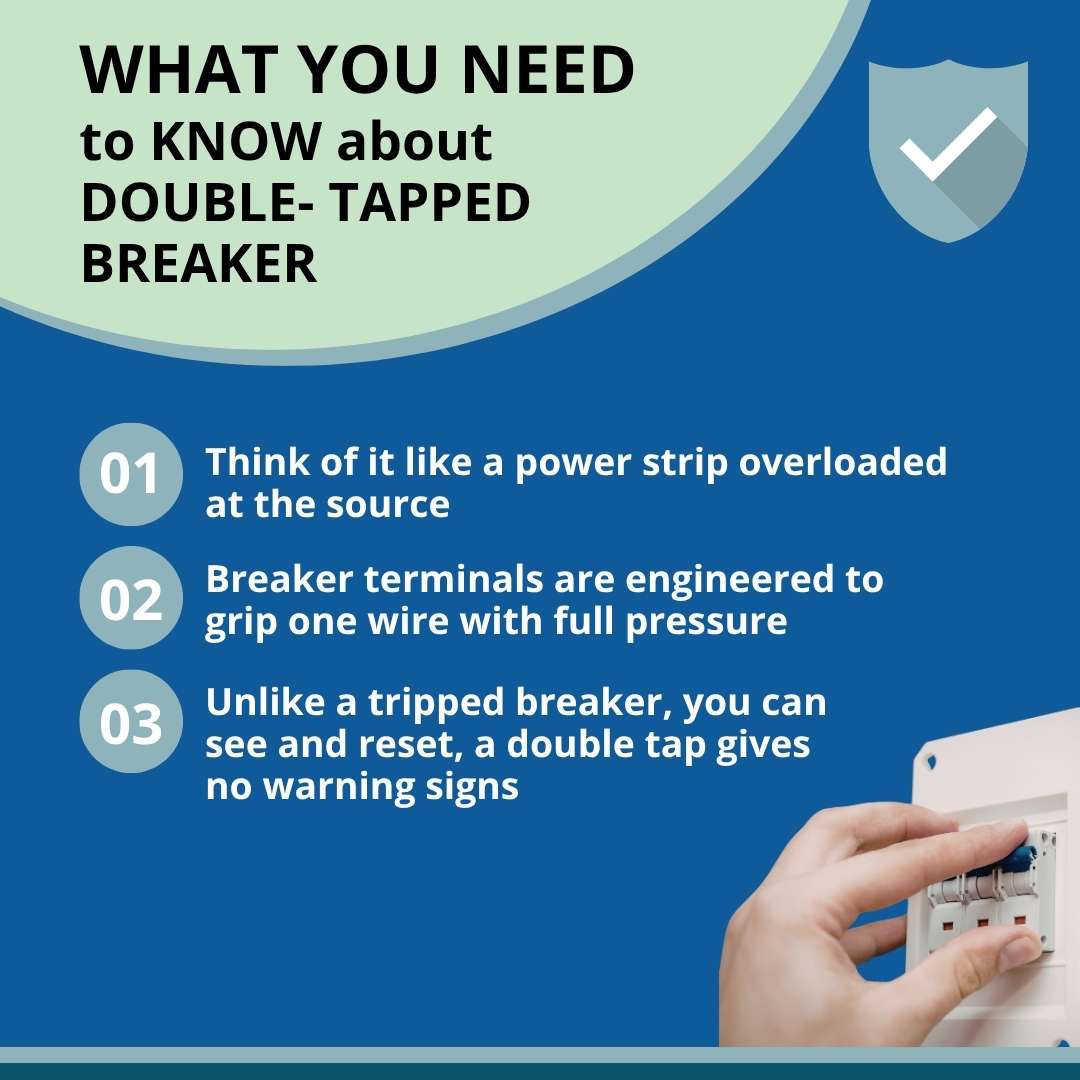
Double-tapped breakers are almost always the result of someone adding a new circuit to a panel that was already full. Instead of installing a new breaker or upgrading the panel, they connected the new wire to an existing breaker. It’s a shortcut, faster and cheaper in the moment, but a safety issue down the line.
This typically happens during:
Even licensed electricians sometimes take this shortcut under time pressure. Finding a double tap in your report doesn’t automatically mean someone was careless, but it does mean it needs to be addressed.
If you’re curious about the other hidden issues that commonly show up in older New England homes, our team has written about common issues found through infrared imaging in New England homes that are just as easy to miss without a thorough inspection.
Here’s the core issue: the terminal screw is designed to clamp firmly against one wire. When two wires are forced under it, the screw can’t hold both equally. One wire sits tight, the other stays loose, and a loose electrical connection is a fire hazard.
When electricity travels through a loose connection, it arcs, creating tiny sparks inside your panel. Arcing generates heat, heat damages insulation, and damaged insulation increases the risk of an electrical fire. The U.S. Fire Administration estimates that electrical malfunctions cause more than 24,000 residential fires every year.
Electrical fires are among the most preventable types of home fires, and panel issues like double taps are exactly what professional inspections are designed to catch before they become dangerous.
There’s also a compounding factor: heat causes wires to expand and contract over time. That thermal cycling makes loose connections even looser, so a minor issue can worsen gradually with no obvious warning signs along the way.
Here’s where it gets a little nuanced and where a knowledgeable inspector makes all the difference.
A small number of breaker brands are actually rated by their manufacturers and UL-listed to accept two conductors under one terminal. The two most common examples are:
For virtually every other brand, GE, Federal Pacific, Zinsco, Murray, two wires under one terminal is not permitted under any circumstances.
| Breaker Brand | Two Conductors Allowed? | Notes & Requirements |
| Square D QO / Homeline (15–30A) | Yes (If labeled) | Copper wire only. The label must show a two-wire graphic. Does NOT apply to GFCI/AFCI breakers. |
| Cutler-Hammer / Eaton CH (15–30A) | Yes (If labeled) | Copper wire only. Uses a dual-groove terminal clamp designed for two wires. |
| GE | No | Single conductor only across all residential models. |
| Federal Pacific Electric (FPE) | No | Major safety hazard; double-tapping significantly increases fire risk. |
| Zinsco | No | Flagged as a hazardous brand; single conductor only. |
| Murray | No | Single conductor only. |
| GFCI / AFCI (Any Brand) | No | These breakers are never rated for two conductors, regardless of the manufacturer. |
During a standard home inspection, the inspector removes the panel’s dead front cover and examines each breaker terminal and bus bar connection individually.
What they’re looking for includes:
A home inspection team that also uses infrared scanning and thermal imaging has a meaningful advantage here. Thermal imaging can detect heat signatures from loose or overloaded connections before they’re visible to the naked eye, catching developing problems before they turn dangerous.
Inspection teams regularly document their real-world panel findings, which gives homeowners a sense of just how frequently these issues turn up during routine inspections.
First, don’t panic. Double-tapped breakers are common, well-understood, and straightforward to fix. Here are the typical options a licensed electrician will consider:
Home Inspection team reinforces what most experienced inspectors will tell you: when a defect is found during an inspection, the right move is always to bring in the appropriate licensed professional, not to ignore it or attempt a DIY fix inside a live panel.
Do not attempt this yourself. Electrical panels carry live voltage even when the main breaker is off.
If a double tap shows up during a home purchase inspection, it’s almost always handled as part of the standard repair negotiation. Because repairs are inexpensive, most sellers either fix the issue before closing or offer a price adjustment. It’s rarely a deal-breaker.
That said, some insurance companies will not issue a homeowner’s policy on a property with known double-tapped breakers, regardless of breaker brand. Getting this resolved quickly protects both the transaction and your coverage.
Understanding why home inspections matter when buying a house goes far beyond double-tapped breakers, but this is a perfect example of an issue that’s invisible during a casual walk-through and only surfaces through a thorough inspection.
A proper home inspection is one of the most valuable investments a buyer can make, and the electrical panel is always on the checklist.
A double-tapped breaker is one of those inspection findings that sounds scarier than it is, but that doesn’t mean it should be ignored. It’s a real electrical safety issue with a straightforward fix, and the fact that your inspector caught it is exactly what an inspection is for.
During a home inspection, the inspector removes the panel’s dead front cover and examines each breaker terminal, the bus bar connections, the wire gauges, and the overall panel condition. They look for double-tapped breakers, double-lugged neutrals, missing knockouts, scorch marks, and signs of overheating. Learn more about what our team covers on our home inspection services page.
Yes, while not every double tap will lead to a fire, the loose connections associated with most double-tapped breakers create arcing, which is a leading cause of electrical fires in residential homes. The risk is real and worth addressing promptly. Our team also uses infrared thermal imaging to detect heat signatures from overloaded or loose connections that aren’t yet visible during a standard visual inspection.
Most double-tapped breaker repairs cost between $150 and $250 per occurrence when handled by a licensed electrician. Simple fixes like adding a new breaker or installing a tandem breaker are typically completed in under two hours. For a full overview of what’s included in a professional inspection, visit our inspection packages page.
A double-tapped breaker is one of those inspection findings that sounds scarier than it is, but that doesn’t mean it should be ignored. It’s a real electrical safety issue with a straightforward, affordable fix. The fact that your inspector caught it is exactly what the inspection process is designed to do: surface the things you can’t see so you can make informed decisions before they become expensive or dangerous problems.
Whether you’re in the middle of a home purchase, preparing to sell, or simply want to know the true condition of the home you’ve lived in for years, the electrical panel is one of the most important systems a professional inspection covers. Double-tapped breakers, loose connections, and outdated wiring are the kinds of findings that protect homeowners, buyers, and their families. Reach out to us today or explore our inspection packages to find the right fit for your home.