
- Book your home inspection online today and save $25 on your next inspection! BOOK NOW!
-
 617-615-9559
 617-615-9559
Fill up the form and we will reach out to help you set up a suitable time slot for your property inspection.
A commercial building inspector examines a property’s structural components, mechanical systems, roofing, electrical, plumbing, HVAC, fire safety equipment, and building documentation to give buyers, investors, and tenants a clear picture of the property’s condition before they commit.
If you’re buying, leasing, or refinancing a commercial property in the Greater Boston area, a professional inspection is one of the most important steps in your due diligence process. This guide covers every major system a commercial inspector evaluates, so you know exactly what to expect.
A commercial building inspection is a comprehensive, visual evaluation of a commercial property. The goal is to identify existing deficiencies, maintenance needs, and potential risks, then document them in a written report you can use to negotiate, plan repairs, or make a go/no-go decision.
Professional commercial inspections follow ASTM Standard E2018, the industry benchmark for what gets examined, how findings are categorized, and what the final report must include. This standard is different from the residential inspection standards used by most home inspectors and is specifically designed for commercial properties.
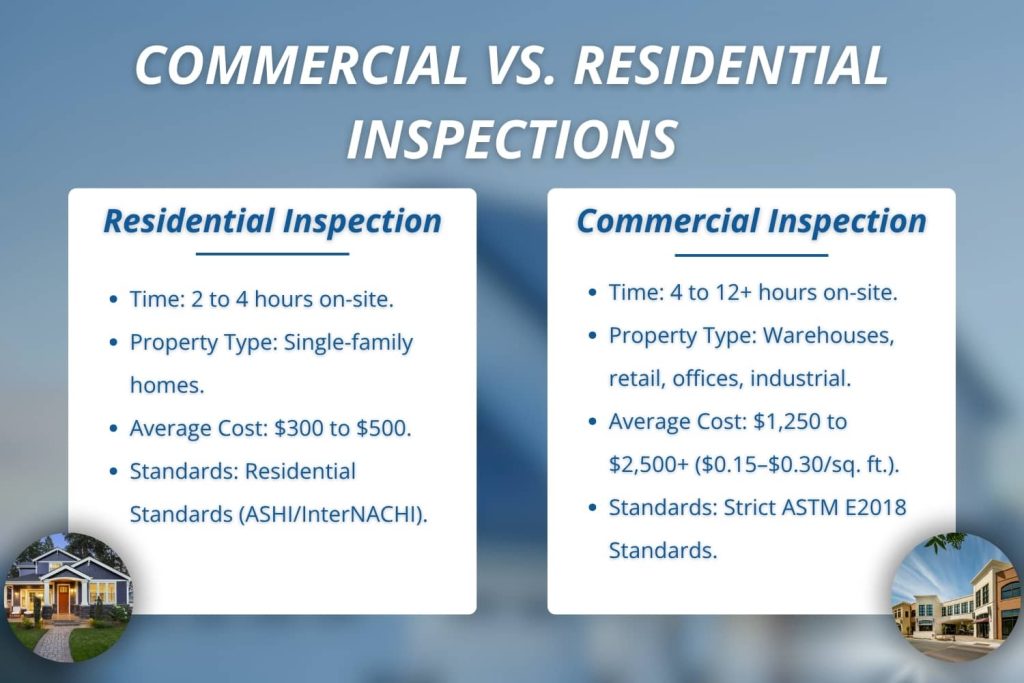
Commercial and residential inspections share the same basic goal, but they differ significantly in scope, cost, and time.
A residential inspection typically covers a single-family home and takes 2 to 4 hours. A commercial inspection covers a business property, which may include multi-tenant office buildings, warehouses, retail centers, industrial facilities, or mixed-use properties. On-site time runs 4 to 12 hours or more, depending on size and complexity.
Costs reflect that difference. Residential inspections average $300 to $500. Commercial inspections typically start around $1,250 and often reach $2,500 or more, with larger properties priced at $0.15 to $0.30 per square foot.
One more term worth knowing: lenders and institutional investors often call this process a Property Condition Assessment (PCA) rather than a “commercial inspection,” but both refer to the same type of evaluation.
A qualified commercial building inspector brings specialized knowledge of commercial-grade systems, including three-phase electrical, commercial flat roofing, large-scale plumbing networks, and ADA compliance requirements. Inspectors with commercial certifications from organizations like InterNACHI have completed training specific to commercial properties and follow a documented commercial inspection standard.
One important distinction: a commercial building inspector is not the same as a municipal building inspector. A municipal inspector is a government employee who enforces local code during construction. A commercial inspector is a private professional you hire for pre-purchase or ongoing due diligence.
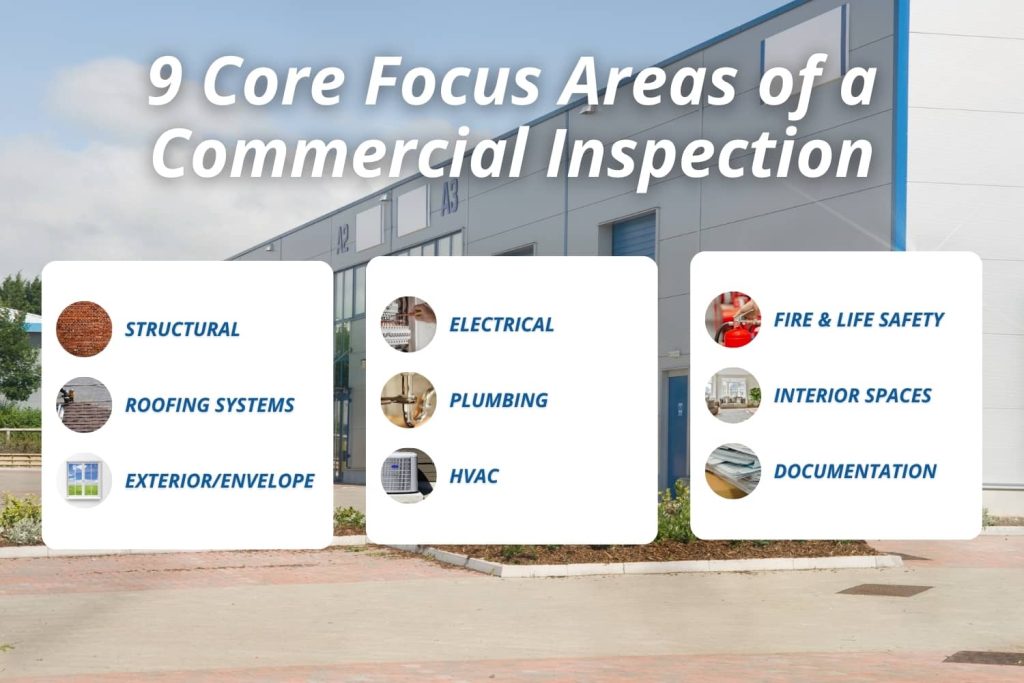
A thorough commercial inspection covers nine major areas. Here is what gets evaluated in each.
The inspector looks at the foundation, load-bearing walls, columns, beams, and floor systems for signs of settlement, cracking, deterioration, or structural movement. Foundation issues are among the most costly deficiencies in any building, and identifying them early can save significant money in purchase negotiations or long-term capital planning.
Commercial roofs are evaluated differently from residential roofs. Most commercial buildings use flat or low-slope roof systems, including TPO, EPDM, built-up roofing, and modified bitumen membranes. The inspector checks membrane condition, drainage, ponding water, flashing, penetrations, and visible signs of leaks or moisture intrusion into the building. Roofing deficiencies are among the most common findings in commercial property reports.
The building envelope includes the walls, windows, doors, and cladding that separate the interior space from the outside environment. The inspector checks for cracks, water infiltration, deteriorated sealants, damaged cladding, and drainage issues around the foundation perimeter. The site is also reviewed, including parking lots, driveways, retaining walls, and landscaping that could affect drainage or building access.
Commercial electrical systems are more complex than residential ones. Inspectors evaluate the main service entrance, distribution panels, transformers, wiring, outlets, lighting, and grounding systems. Three-phase power systems, common in industrial and larger commercial properties, require specialized knowledge to assess accurately. The inspector also notes the condition and age of wiring and panels relative to the building’s current occupant load.
The inspector traces the visible plumbing network, including supply lines, drain-waste-vent systems, water heaters, and fixtures throughout the building. Signs of leaks, corrosion, improper repairs, slow drains, and water pressure issues are all noted. In older commercial buildings, pipe material condition (galvanized, cast iron, or older plastics) is a key factor in the report findings.
Heating, ventilation, and air conditioning systems are a major maintenance and capital cost item in commercial buildings. The inspector evaluates equipment age and condition, filters, ductwork, thermostats, exhaust systems, and rooftop units. A well-maintained HVAC system directly
affects occupant comfort, indoor air quality, and energy costs, so this section of the report often generates the most questions from buyers.
The inspector reviews sprinkler systems, fire alarm panels, emergency lighting, exit signage, and fire extinguisher placement.
Per the National Fire Protection Association, commercial building fire safety requirements vary by occupancy classification, but all commercial properties must meet minimum standards for sprinkler coverage, alarm systems, and exit illumination.
A fire safety deficiency may require immediate correction depending on the building’s occupancy type.
Inside the building, the inspector walks all accessible areas, including offices, restrooms, common areas, stairwells, and mechanical rooms. Walls, ceilings, and floors are checked for moisture damage, cracking, and deferred maintenance.
ADA compliance items, such as door widths, bathroom clearances, and accessible routes, may be noted as well, though a full ADA compliance audit is a separate, specialized service.
Beyond the physical building, the inspector may review available documentation, including prior inspection reports, permits for recent renovations, maintenance records, and equipment warranties.
While a commercial inspector does not conduct a formal code compliance audit, they do flag visible conditions that appear inconsistent with current building standards and recommend follow-up with appropriate specialists where needed.
For a deeper look at what commercial inspections cover, see our complete guide to commercial inspections.
After the on-site visit, you receive a Property Condition Report (PCR), which documents all findings with photos, descriptions, and recommended next steps. Findings are typically categorized by urgency:
The PCR does not give a building a passing or failing grade. It gives you a documented, photo-supported picture of the property’s condition so you can negotiate, plan, or walk away based on real data.
At R&C Inspectors, our reports are delivered with clear photo documentation and written descriptions of every finding, giving commercial buyers and investors in the Boston area everything they need to make an informed decision. For an overview of how the inspection process supports investment decisions, see our post on the role of commercial inspections in property investment.
Commercial inspection costs vary based on property size, type, and scope. Here is a general guide:
|
Property Type |
Typical Cost Range |
|---|---|
|
Small retail or office space (under 5,000 sq ft) |
$750 to $1,500 |
|
Mid-size commercial building (5,000 to 20,000 sq ft) |
$1,500 to $3,000 |
|
Large industrial or multi-tenant building (over 20,000 sq ft) |
$2,500 to $5,000+ |
|
Lender-required PCA (ASTM E2018 standard) |
$3,000 to $8,000+ |
The cost of a professional inspection is minor compared to discovering a $200,000 roof replacement or foundation issue after closing. Most buyers and lenders treat it as required due diligence, not an optional expense. To learn more about what to watch for in a commercial building before and after the inspection, see our post on creating healthy commercial spaces.
Do commercial property inspections cover environmental hazards like radon or mold?
Standard building assessments focus primarily on structural and mechanical systems. Specialized environmental testing, such as radon gas testing or indoor air quality testing services in Boston, MA, must typically be added as ancillary services. Assessing air and soil quality is highly recommended for commercial spaces, multi-family properties, and residential buildings to limit liability and protect occupant health.
How can buyers identify hidden structural, electrical, or insulation defects?
Many critical building defects are invisible to the naked eye. Utilizing infrared scanning during an inspection allows professionals to detect thermal anomalies, hidden moisture plumes, insulation gaps, and electrical hotspots behind walls or under roof membranes without causing physical damage to the property.
Are pest and termite inspections necessary for commercial real estate?
Yes. While often associated with residential properties, a dedicated termite inspection or comprehensive pest inspection is a vital part of due diligence. Rodents and wood-destroying insects can compromise the structural integrity of a building and create severe health code violations for businesses.
What is the primary difference between a commercial assessment and a standard home inspection?
A standard home inspection is designed for residential properties, focusing on single-family living systems and safety standards. Commercial inspections follow the strict ASTM E2018 industry standard to evaluate complex, industrial-grade systems, larger operational capacities, and commercial-specific liabilities that do not apply to residential real estate.
When should a property owner consider testing the building’s water supply?
Comprehensive water quality testing is highly recommended if a property relies on a private well, has older commercial plumbing networks (like galvanized iron or lead), or is being used for hospitality, medical, or educational purposes. Testing ensures the water is free of harmful contaminants and completely safe for public consumption.
A commercial building inspection makes sense any time significant money, a long-term commitment, or occupant safety is involved. The most common scenarios:
Commercial building inspections are not a do-it-yourself task. The systems involved, including three-phase electrical, commercial roofing membranes, large-scale HVAC, and fire suppression networks, require specialized training and equipment to evaluate accurately.
If you own, are purchasing, or are leasing a commercial property in Greater Boston, the team at R&C Inspectors brings 15 years of experience and state-of-the-art tools to every inspection. We provide detailed, unbiased reports with photographic documentation so you can move forward with confidence. Contact us to schedule your commercial building inspection.
A commercial building inspector looks at everything from the foundation to the roof, including all major mechanical systems, fire safety equipment, interior spaces, and building documentation. There is no pass or fail; you get a full, photo-documented picture of the property’s current condition before you commit.
Key takeaways:
When you’re ready to schedule a commercial inspection in the Greater Boston area, our team is here to help. Review our complete guide to commercial inspections or contact us to get started.