
- Book your home inspection online today and save $25 on your next inspection! BOOK NOW!
-
 617-615-9559
 617-615-9559
Fill up the form and we will reach out to help you set up a suitable time slot for your property inspection.
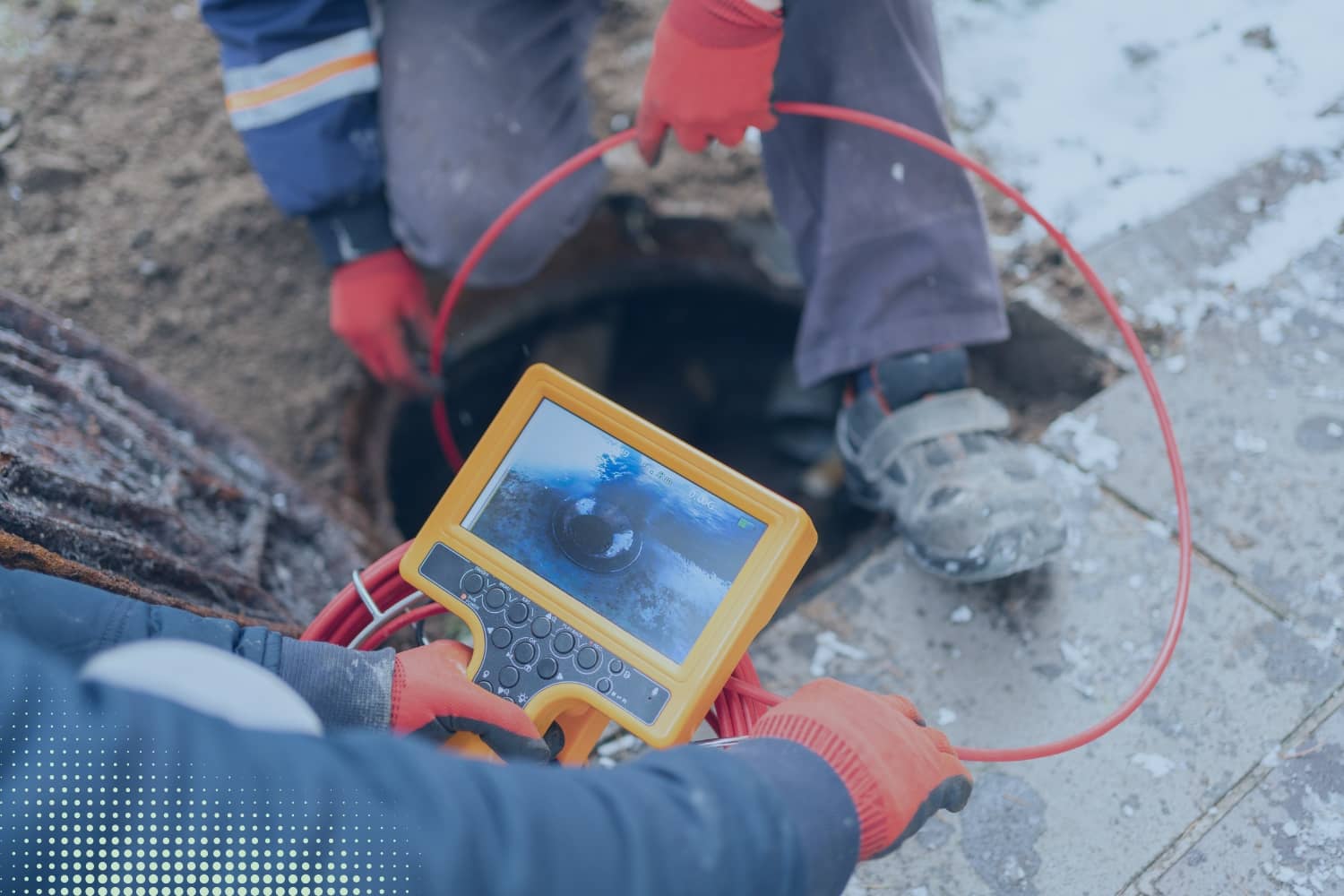
A sewer scope inspection uses a video camera to examine the underground pipe that carries wastewater from your home to the city’s main sewer line, revealing cracks, root intrusion, pipe collapse, and other serious problems before they become expensive surprises.
This service is not part of a standard home inspection. Thousands of buyers in Greater Boston close on a property without one, and discover a failing sewer line months later.
At R&C Inspectors, we see this regularly. This post walks you through what a sewer scope inspection looks for, the most common findings, what your pipe material means for your risk level, and when to add one to your inspection package.
A sewer scope inspection is a video examination of your home’s lateral sewer line: the underground pipe that carries all household wastewater from the foundation to the city’s main sewer or your septic tank inlet.
A certified inspector feeds a waterproof camera through a cleanout access point, records the full pipe run on video, and identifies damage, defects, and blockages in real time.
The lateral line is your responsibility as a homeowner from the day you close. If it fails, the repair cost is yours. That single fact is why a sewer scope inspection delivers some of the highest return on investment of any optional add-on service.
A standard home inspection does not cover the sewer lateral. The underground location and camera requirement put it outside the scope of a visual inspection. Adding a sewer scope is the only reliable way to know the condition of the line before you own it.
Per InterNACHI’s Standards of Practice for Sewer Scope Inspections, a compliant sewer scope includes camera access, full lateral coverage, and a written report: not just a verbal summary. When you book this service, confirm those three elements are included.
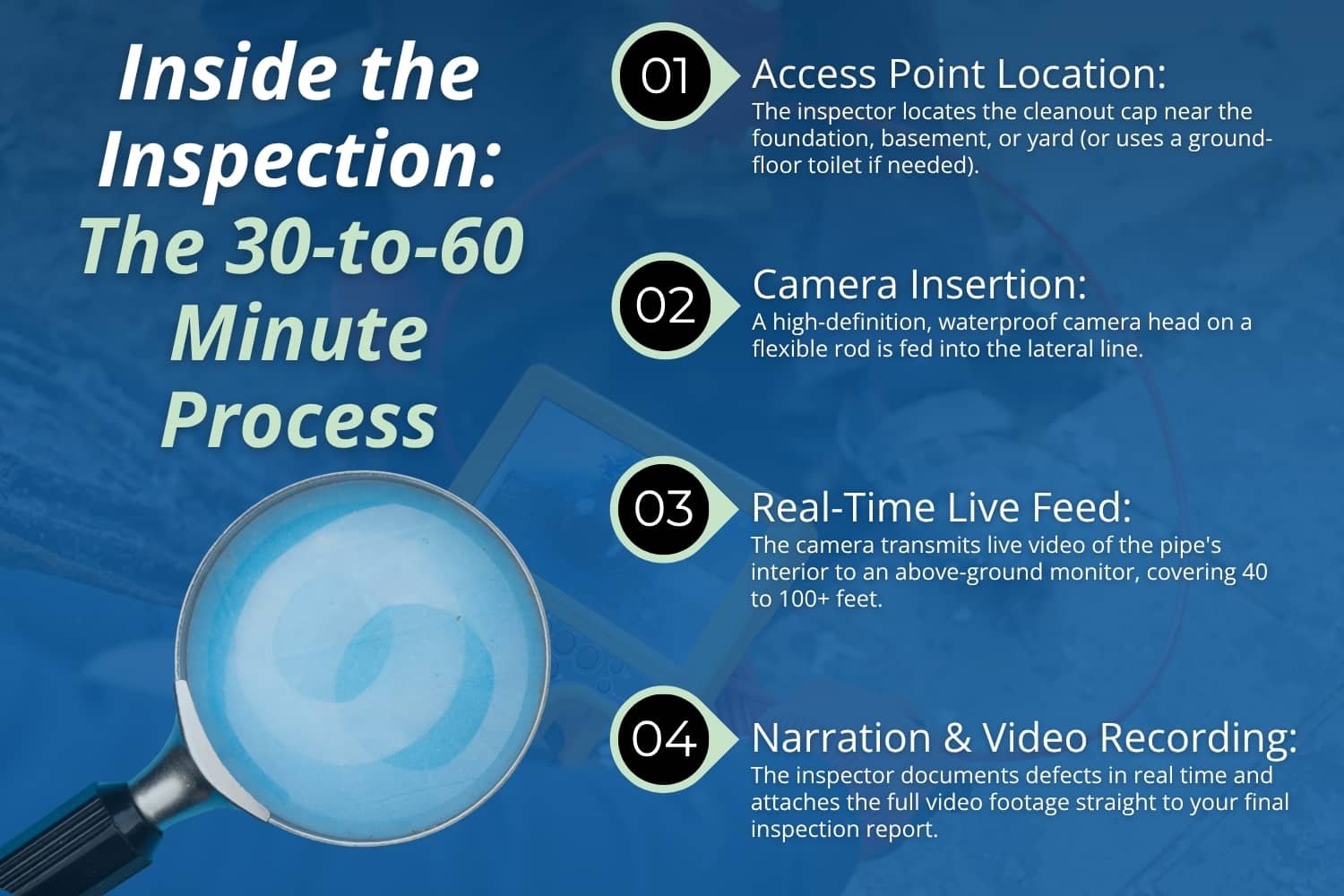
During the inspection, your inspector locates the cleanout access point. This is typically a capped pipe near the foundation, in the basement, or in the yard. If no cleanout exists, the camera can sometimes be run through a ground-floor toilet, though that adds time and cost.
Once access is set, the inspector feeds a flexible rod with a high-definition camera head through the pipe. The camera transmits live video to a monitor above ground. The inspector moves through the entire lateral (usually 40 to 100 or more feet) and narrates what they observe.
The footage is recorded and included in your inspection report, so you have documentation to take to your agent or attorney.
The full process takes 30 to 60 minutes in most cases. If you can, be present. Watching the footage in real time lets you ask questions and see the findings directly rather than reading them on paper later.
A sewer scope looks for any condition that reduces the pipe’s ability to carry wastewater safely. The most common findings include:
Roots grow toward moisture and enter pipe joints and cracks. They can partially or completely block the lateral if left untreated. Root intrusion is the most common finding in sewer scope inspections, particularly in older neighborhoods with mature trees.
For homes on the South Shore and in Greater Boston, where neighborhoods are heavily treed, this is a top concern.
A belly is a low spot in the pipe caused by soil settlement or poor original installation. Water and debris collect in the belly rather than flowing toward the main. Repeated backups in a home often trace back to pipe bellying rather than a surface clog.
Pipes crack from ground movement, freeze-thaw cycles, vehicle traffic above the line, and age. A partially collapsed section is a serious finding that typically requires prompt repair. New England winters accelerate pipe stress, especially in older clay tile and cast iron lines.
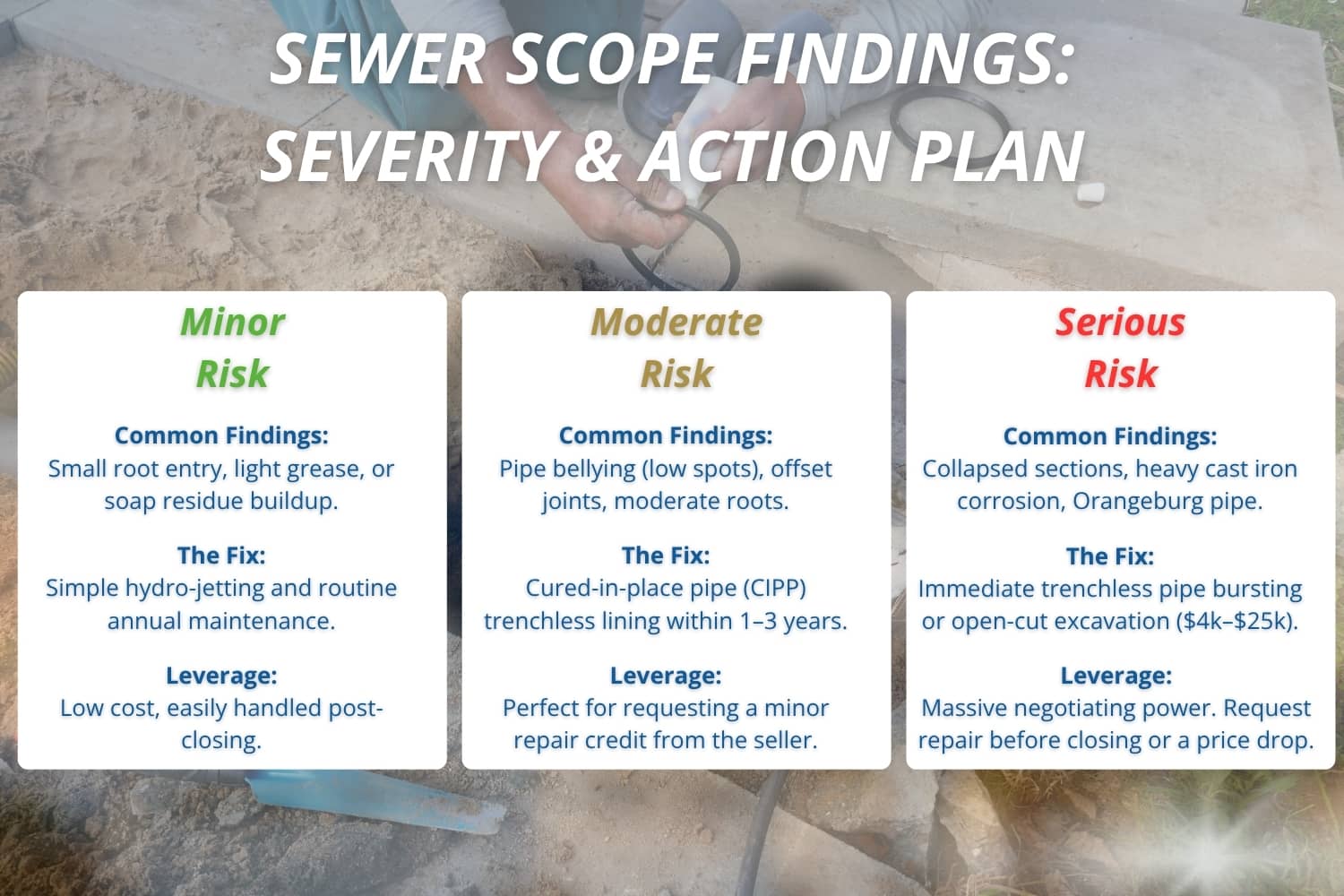
Years of cooking grease, soap residue, and sediment build up on the inside of the pipe and reduce its flow capacity. Heavy buildup causes frequent slow drains and backups. This is one of the more treatable findings: hydro-jetting clears most buildup effectively.
Cast iron pipes corrode from the inside out over time. Heavy corrosion pits the pipe wall and eventually leads to holes and structural failure. A scope shows the severity of corrosion and helps estimate how much service life remains.
When two pipe sections shift out of alignment from soil movement or frost heave, the resulting offset catches debris and roots. Offset joints are a common finding in New England homes, where cold-season ground movement is a regular factor.
The age of your home gives the first clue about what is in the ground. Different materials have different expected lifespans and typical failure modes.
| Pipe Material | Typical Era | Est. Lifespan | Common Failure Mode |
|---|---|---|---|
| Clay tile | Pre-1960s | 50–100 years | Root intrusion at joints, cracked sections |
| Cast iron | 1900s–1980s | 75–100 years | Interior corrosion, heavy scaling |
| Orangeburg | 1940s–1970s | 50 years or less | Delamination, pipe wall collapse |
| ABS / PVC | 1970s–present | 100+ years | Offset joints, root intrusion at fittings |
For older homes, the U.S. EPA’s guidance on sewer system maintenance notes that aging infrastructure requires periodic inspection to catch deterioration before failure. The same principle applies to your lateral.
Add a sewer scope inspection to your home inspection if any of the following apply:
New construction homes are not automatically safe. Construction debris, gravel, broken concrete, and joint compound left in the pipe are a frequent finding. Improperly sloped pipes create bellies that will cause problems within years of move-in.
A scope on a new home confirms the pipe is correctly installed and clear before you take ownership.
If your home uses a septic system rather than the city sewer, a sewer scope is a separate service from a septic inspection. The scope examines the lateral from the house to the tank inlet. The tank, distribution box, and leach field require a different inspection entirely.
For a complete picture of what a home inspection covers (and what falls outside it), see our post on the importance of home inspections when buying a house.
Sewer scope inspection pricing varies by region, inspector, and how the service is booked. As an add-on to a bundled home inspection, the cost is typically lower than scheduling it as a standalone service.
If no cleanout exists and the camera needs to enter through a toilet, expect an additional charge for the extra setup time and complexity.
Contact R&C Inspectors directly for current pricing in the Greater Boston and South Shore area.
The more important comparison is what you risk by skipping the service.
A lateral sewer replacement by trenchless methods in Massachusetts typically runs $4,000 to $15,000. Open-cut excavation in established neighborhoods, where mature landscaping, tight lots, and utility conflicts complicate the work, can exceed $25,000.
A sewer scope inspection costs a small fraction of that, and it gives you the information you need before you own the problem.
Not every finding requires immediate action. A good inspector explains what was found, what it means in practical terms, and what your options are.
If you are still in the purchase window: A sewer scope finding gives you real negotiating power at the closing table.
You can request that the seller repair the lateral before closing, reduce the sale price by the cost of repair, or provide a credit at closing. Buyers who skip the scope give up that position entirely. Buyers who get the scope get documentation and options.
Ask your inspector to walk you through the footage before you leave. A qualified inspector helps you separate a cosmetic condition from a structural one, so you can make a confident decision. For more on how foundation-related conditions near the lateral path interact with sewer line stress, see our post on basement foundation cracks and what they mean.
What other assessments should be paired with a sewer scope during a property purchase?
A sewer scope focuses entirely on the exterior underground lateral line. To understand the condition of the rest of the property, a comprehensive home inspection is essential to evaluate the interior plumbing fixtures, electrical systems, roofing, and overall structural integrity.
How do inspectors find hidden pipe leaks inside the house?
A sewer scope only looks inside the main line leading out to the street. To locate active water leaks hidden behind drywall or beneath flooring without tearing up the house, inspectors use infrared scanning to track hidden moisture footprints and thermal anomalies.
Can a broken underground sewer line attract pests to the property?
Separated or cracked pipes saturate the surrounding soil with moisture and organic waste, creating an ideal environment for pests. If a scope reveals significant leakage near the foundation, following up with a professional termite inspection or a broader pest inspection ensures these critters haven’t migrated into the home’s wooden framing.
Does a sewer scope evaluate the safety of the home’s drinking water?
No, waste lines and incoming supply lines are entirely separate systems. While a scope ensures your wastewater leaves the property without obstruction, a dedicated water quality testing service is required to verify that the home’s drinking water is free from lead, radon, or chemical contaminants.
If you are experiencing repeated drain backups, sewage odor inside the home, or unexplained wet spots in the yard above your lateral line path, do not wait. These are signs of an active sewer line problem that a camera inspection can identify fast.
At R&C Inspectors, we use state-of-the-art camera equipment to inspect the full run of your lateral line and provide a detailed report immediately after the inspection. Our inspectors are unbiased and thorough.
We serve home buyers, homeowners, and real estate agents across Greater Boston, Weymouth, and the South Shore. Whether you are adding a sewer scope to a full home inspection or scheduling a standalone service, we give you the clear picture you need to move forward with confidence.
A sewer scope inspection gives you a clear look at one of the most expensive and least visible systems in any home. It costs a fraction of what a lateral sewer line repair costs, and it gives you real options at the closing table when problems are found.
Before you close on your next home in the Greater Boston area, add a sewer scope to your inspection package for peace of mind. Our team at R&C Inspectors is ready to help you book your sewer scope inspection.
Key takeaways:
Ready to book? Contact R&C Inspectors to schedule your sewer scope inspection.