
- Book your home inspection online today and save $25 on your next inspection! BOOK NOW!
-
 617-615-9559
 617-615-9559
Fill up the form and we will reach out to help you set up a suitable time slot for your property inspection.

In most Massachusetts home sales, the buyer pays for the home inspection. You hire the inspector, you pay the fee, and you own the report. Sellers do pay for a few inspections, such as a pre-listing inspection, the Title 5 septic inspection, and the smoke detector certificate. At R & C Inspectors, we have spent the last 15 years inspecting homes for buyers across Greater Boston and the South Shore, and this question comes up on almost every first call. Below, we break down who pays for what, how state law protects your right to an inspection, and how your report can help you get repairs covered.
The buyer pays for the home inspection when buying a house. The inspection protects the buyer, so the buyer hires the inspector and covers the fee.
| Inspection or cost | Who usually pays | Notes |
|---|---|---|
| General home inspection | Buyer | Paid at booking or on inspection day |
| Add-on tests (radon, water, sewer scope, termite) | Buyer | Often booked alongside the home inspection |
| Pre-listing inspection | Seller | Ordered before the home goes on the market |
| Title 5 septic inspection | Seller | Required for homes on septic; can be shifted in writing |
| Smoke and CO detector certificate | Seller | Issued by the local fire department before closing |
| Lead paint inspection (homes built before 1978) | Buyer, if they want one | Seller must give the lead paint notification |
| Appraisal | Buyer | Ordered by the mortgage lender |
| Repairs found during the inspection | Negotiated | Seller fixes, credit at closing, or price cut |
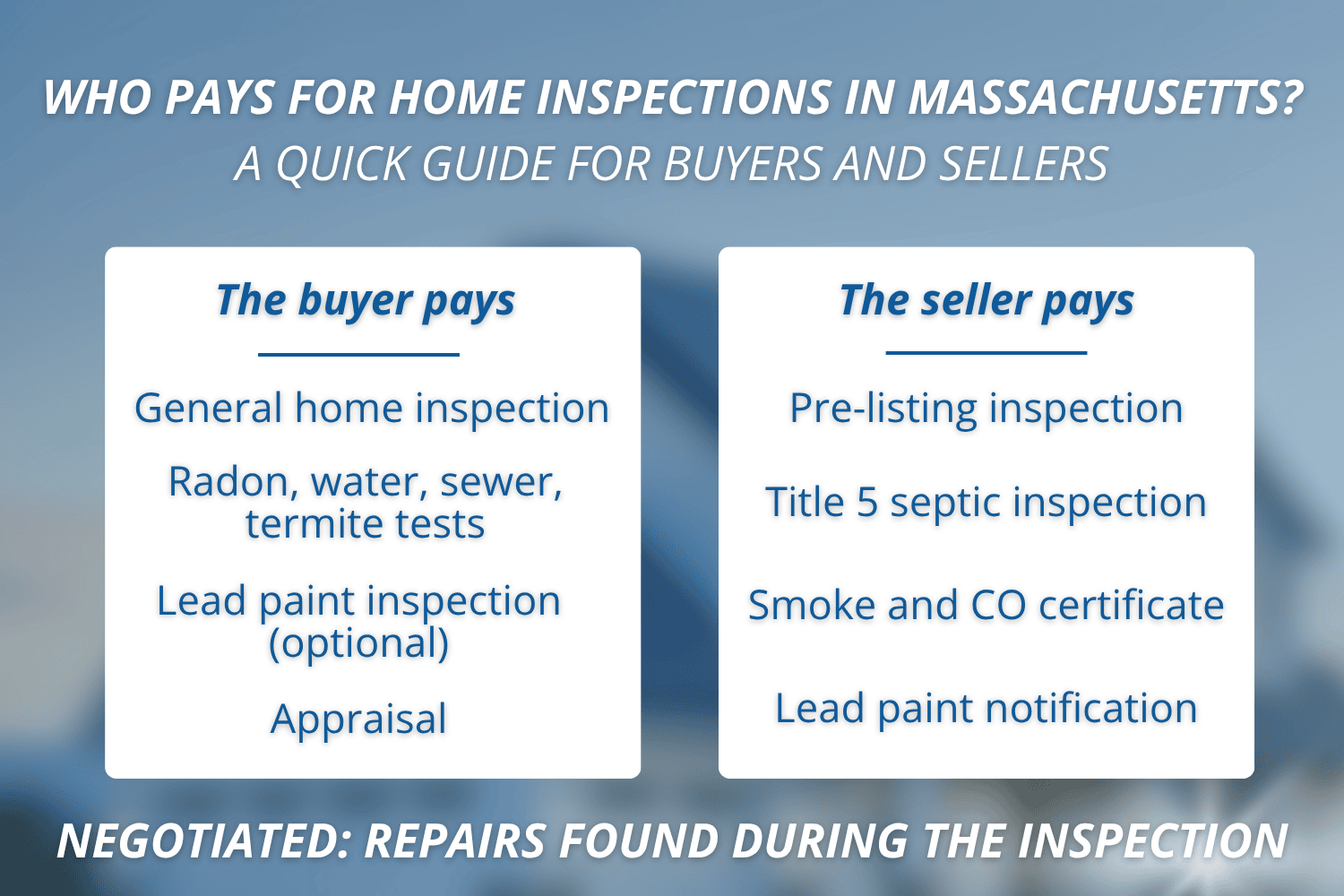
The buyer pays because the inspection works for the buyer. It is part of your due diligence before you commit to one of the biggest purchases of your life.
When you hire the inspector, the inspector works for you. That matters. You get an honest, unbiased look at the property, and nobody else controls what goes in the report. If the seller hired and paid the inspector, you might fairly wonder whose side that inspector was on.
Paying also means the report belongs to you. You decide who sees it and when. In Greater Boston, where many homes are 80 to 120 years old, that report is your best tool for spotting problems like aging boilers, outdated wiring, and knob and tube wiring in older Boston homes before you close.
The seller pays when the seller orders the inspection or when state law puts the job on the seller. In Massachusetts, that covers three common cases.
Some sellers hire an inspector before they list. A pre-listing inspection shows them what a buyer’s inspector will likely find. That gives them time to fix problems on their own schedule, price the home well, and avoid surprises during negotiations.
The seller pays for this inspection and controls the report. As a buyer, you can read it, but it doesn’t replace your own inspection. The seller’s inspector worked for the seller, not for you.
If a home uses a septic system instead of town sewer, Massachusetts Title 5 rules require an inspection before the property changes hands. The property owner is responsible for arranging it, so the seller usually pays. The buyer and seller can agree in writing to shift that job, as long as the inspection still happens on time. A passing inspection is generally good for two years, or three years if the seller has records showing the system was pumped every year. The state’s guide to buying or selling property with a septic system covers the details.
A standard home inspection does not include a Title 5 inspection. It must be done by a MassDEP-approved system inspector.
Before a home sells in Massachusetts, the seller must get a certificate from the local fire department showing the smoke and carbon monoxide alarms meet state rules. The seller schedules the visit and pays the fee.
Yes, if both sides agree. Almost everything in a home sale can be negotiated. In a slower market, a seller might offer to cover an add-on test, like radon or a sewer scope, to keep a deal moving. Just make sure you are still the inspector’s client. The person who hires the inspector is the person the report serves.
A general home inspection usually costs a few hundred dollars. National averages run about $300 to $500, and prices in Greater Boston can land higher because of home size, age, and building type.
What changes the price:
You can compare options on our home inspection packages page, and you save $25 when you book online.
Massachusetts does not require buyers to get a home inspection. But since October 15, 2025, a seller cannot make waiving the inspection a condition of the sale.
The rule comes from the 2024 Affordable Homes Act and a state regulation called 760 CMR 74.00. Here is what it means for you:
Massachusetts also limits who can point you to an inspector. Real estate agents other than your own buyer’s agent can’t recommend a specific inspector to you. You’ll get a state fact sheet on home inspectors instead.
For buyers, the law doesn’t change who pays. You still pay for your inspection. What it changes is the pressure to skip one. Plan and budget for your inspection from the start.
Repairs are negotiated between the buyer and the seller. No rule says the seller must fix what the inspector finds, so your report becomes your main negotiating tool.
Common outcomes:
A few tips make these talks go smoother. Focus on safety issues and major systems, like the roof, heating, electrical, plumbing, and foundation. Skip small cosmetic items. Get contractor estimates for big-ticket repairs so your request is backed by real numbers. Your agent can help you decide which items are worth asking for.
Keep in mind that sellers in Massachusetts can still sell a home “as is.” The new law protects your right to inspect, not your right to repairs.
Not automatically. The buyer pays for the inspection, so the buyer owns the report. Many buyers share the pages that support a repair request during negotiations. If the seller paid for a pre-listing inspection, the seller controls that report.
No. You pay the inspector for the work, whether you buy the house or not. That is the point of an inspection contingency. A few hundred dollars spent to learn about a failing foundation is far cheaper than owning it.
Usually not. Most buyers pay the inspector directly before or on inspection day. The fee may still appear on your closing paperwork as a cost “paid outside of closing,” but you cover it upfront.
No. Neither the state nor most lenders require one. Lenders require an appraisal, which checks value, not condition. We still recommend a professional home inspection for every purchase, and state law now stops sellers from pressuring you to skip it. If you have one on the calendar, here’s how to prepare for your home inspection.
The buyer usually pays for these add-on tests, just like the general inspection. They are worth it for many Greater Boston homes. Our radon gas testing measures levels over 48 hours, and a sewer scope shows the pipe you can’t see. Learn what sewer scope inspections look for.
The buyer usually pays for the appraisal. Your lender orders it to confirm the home is worth the loan amount. An appraisal and an inspection are different. The appraisal protects the lender, and the inspection protects you.
Call a home inspector as soon as your offer is accepted. Your inspection window is short, and busy seasons fill up fast. If you are shopping in spring or summer, it helps to line up an inspector before you make an offer.
Sellers should call before listing. A pre-listing inspection gives you time to fix issues and price the home with confidence.
R & C Inspectors serves Greater Boston and the South Shore, including Weymouth, Quincy, Newton, Waltham, Medford, and Somerville. Most inspections take 1.5 to 3 hours. You are welcome to attend and ask questions as we go, and your report arrives the same day.
Buying a home soon? Schedule your home inspection with R & C Inspectors and walk into closing knowing exactly what you’re getting.